
Food and Drink

And the Beet Goes On . . .

Last month, on the NPR program “Here and Now,” a chef named Kathy Gunst gave one of the most effective sales presentations I’ve ever heard. About beets. I was listening in the car, and by the time she was finished with a 10-minute interview, I was ready to drive straight to Safeway, buy a bunch of beets, take them home and cook them.

In spite of two facts: a), I’m really not excited about beets, and b), I’m definitely not excited about cooking.

How did she get me so excited about a fat red vegetable I don’t even care about? She used six tools to create an unbeetable way to sell an idea. Here’s how she did it:

Stay UpBeet. I don’t care much for beets, but Kathy obviously does. Her enthusiasm about them was genuine. The energy she gave off was contagious and let even a lukewarm beet-eater like me “Catch the Beet.”

Beet Your Own Drum. Not once during the program did I hear Kathy say “you should” or “you need.” She didn’t tell us that we ought to like beets or why; she just talked about what she liked about them.

Lay Down a Beautiful Beet. This was radio, remember. All she had to work with was words. And yet she used words to appeal not just to our ears, but to all our senses. She described the flavor and texture of beets in specific terms and made them sound delicious. She talked about the different colors of beets—not just red, but orange and yellow and white. She described slices of the different colors arranged on a platter so vividly that I could see it.

Don’t Beet Around the Bush. Kathy was direct and clear when she talked about the nutritional value of beets. They contain B vitamins, fiber, folates, anti-oxidants, and all sorts of other stuff that’s good for us. She gave us the basics in a way that was easy to understand and remember.

Keep a Simple Beet. On the rare occasions that I catch part of a cooking show, I am usually daunted by their elaborate recipes and complicated processes. Half the time they use ingredients I’ve never heard of, can’t spell, or have no idea how to pronounce. Instead, Kathy made cooking beets seem easy. Just roast them—which is simple and also keeps in the nutrients and enhances the flavor. Even better, it makes them easy to peel. Just put on disposable plastic gloves or stick your hand inside a plastic bag and rub the skin off. No mess, no staining, no sweat. She made it sound so easy even I could do it.

Know How Long to Let the Beet Go On. Kathy was brisk and packed a lot of information into her presentation. She focused on the right sized bite for the time she had. She said her say and then Beat It. She didn’t let the Beet Go On, and On, and On.

Since this presentation was so effective, did it work for me? Well, sort of. Even though I was tempted, I didn’t drive to the grocery store and buy some beets. However, I did get excited enough to look them up.

And Kathy wasn’t kidding about the health benefits. Beets are great food. In fact, according to one account I found, they might even be great medicine.

In a small rural hospital in Siberia, during a blizzard, a doctor had to do emergency open-heart surgery on a middle-aged man. The surgery went well, but the man needed blood transfusions and the hospital’s supply of blood was gone. Blood donors couldn’t get to the hospital because of the storm. The doctor took blood from every possible donor on the hospital staff, including himself. It still wasn’t enough. At last, in desperation, the doctor caught sight of an orderly going past the OR with a food cart. On it were bowls of borscht—beet soup. The doctor knew his patient was close to death. There was nothing to lose. He grabbed the food cart, hooked up an IV, and transfused the patient with borscht.

Miraculously, the man started to recover. After a week in the hospital, he went home, and he has gone on to lead a healthy, active life. He has just one small problem.

Every now and then, his heart skips a beet.
Categories: Food and Drink | Tags: , , | 2 Comments

Finger Bowling

Finger bowls. I’ve always associated them with formal dining, elegant place settings, and fine china. This impression, based on extensive reading of historical novels, was confirmed when I did a little research. I accidentally wandered into the thickets of the 1922 edition of Emily Post’s Etiquette and found it such fascinating reading that I very nearly didn’t come out again. (Just in case you need to know the correct precedence for seating guests, the appropriate division of responsibilities between the butler and the housekeeper, or the proper way to address an envelope or a Duke, you can find the book here.)

Emily (I suppose I should call her Mrs. Post, but after half an hour of browsing through her crisp prose I feel as if we know each other) seems to assume finger bowls are standard at formal dinners, merely describing two different ways of presenting them with the dessert course. She mentions as a matter of course that the finger bowl is always placed on a doily, which may be round or square but “must always be cream or white.” She also says, “the finger bowl is less than half filled with cold water; and at dinner parties, a few violets, sweet peas, or occasionally a gardenia, is put in it. (A slice of lemon is never seen outside of a chop-house where eating with the fingers may necessitate the lemon in removing grease. Pretty thought!)”

Emily’s parenthetical shudder notwithstanding, in the circumstances recently where I used a finger bowl for the first time, the lemon might have been useful.

We were invited to dinner at the home of a couple who have lived abroad and are familiar with a variety of dining styles. I was slightly intimidated at first to see, at each plate, a pretty little blue-and-white finger bowl. Then the hostess informed us that the main course was barbequed pork ribs. She encouraged us by both word and example to eat them with her fingers, making full use of the finger bowls.

I’m not sure Emily would have approved, but the finger bowls in this instance were utterly practical. The process went like this:
• Pick up rib with fingers and eat the meat, making sure to gnaw the last delicious bites off of the bone.
• Lick fingers (optional, but highly recommended—the sauce was tasty).
• Paddle fingers gently in finger bowl.
• Wipe clean fingers on napkin.
• Pick up fork with sauce-free fingers and take a few bites of veggies and rice.
• While fingers are still clean, pick up serving fork and stab another pair of ribs.
• Repeat and rinse, as often as appropriate—but not too often, since there were chocolate brownies for dessert.

Now that I understand the practical value of finger bowls in non-formal settings, I may just have to try this at home. They could be especially useful for family dinners with small children at the table. Just image the convenience of having finger bowls at hand for toddlers to use after they finish eating spaghetti with their fingers, scooping up applesauce with their forks, dipping their green beans in ketchup, or dredging the noodles out of their soup by hand. They could rinse off their sticky little fingers before wiping them on their own pants, the tablecloth, or their grandmother’s new sweater. This could be the most useful dinner-table accessory for little ones since the unabridged dictionary.

It wouldn’t even be necessary to put violets or sweet peas in toddlers’ finger bowls. They would decorate their own—not only with peas, but with other attractive accents like lumps of mashed potatoes, rejected bites of chicken, stray strings of spaghetti, and the entire contents of the salt shaker.

Of course, being creative little souls, no doubt they would also find alternative uses for the water in the bowls: drinking it, using it to finger paint on the table, spitting it at one another, or pouring it onto their plates, the table, their laps, their heads, or the floor.

Oops. Maybe this idea needs a bit of refining. Besides, I just remembered one more thing about those historical novels that refer to finger bowls. All the elegantly dressed people at those formal multi-course dinners, making refined conversation while the maids and footmen serve them so correctly, are adults. The children, duly supervised by nurses and nannies, eat in the nursery.

Categories: Food and Drink | Tags: , | 3 Comments

I Could Quit Any Time

They’re everywhere this time of year. Christmas cookies. Pie. Hot cocoa. Gift boxes of chocolates. Stockings full of sweets.

And one of the most common New Year’s resolutions is to lose weight.

Irony? Coincidence? Or cause and effect? Regardless, it’s a good thing we have that week between Christmas and New Year’s to get everything eaten.

Some of us (naming no names, but you know who I am) don’t do any holiday baking. We have two options: to rely on the kindness of more culinarily ambitious friends and family members, or to buy our own goodies.

Theoretically, I suppose, there is a third choice—to go without—but that’s merely an absurd technicality.

Fortunately, when one has a reputation as a chocolate addict, friends and family can generally be counted on for gifts of one’s substance of choice. Being seen as a chocoholic is especially useful this time of year.

However, in my case, that reputation is totally undeserved.

Oh, I love chocolate. Dark chocolate, especially. I eat some almost every day. I make sure to keep a stash of the stuff. But I am not an addict.

Here’s my supporting evidence:

• This Christmas, freely and with a glad heart, I sent a bag of dark chocolate M&M’s to a family member even though I originally bought it for myself. (Yes, I bought myself another bag the next day; why would you ask?)

• A few years ago I spent several weeks in a foreign country at a geology field camp. I hardly had any chocolate the whole time, and I didn’t suffer a single pang of withdrawal. In fact, I barely noticed. By now I’ve practically forgotten all about it.

• Not all chocolate is created equal; I have standards. A Tootsie Roll (it’s a texture thing) could stay uneaten on my kitchen counter for years. S’mores are way too sweet and gooey. Chocolate ice cream is too much chocolate; vanilla with chocolate syrup is much better. Chocolate Nutella is simply disgusting. And there are some places chocolate simply does not belong, such as pecan pie, animal crackers, and baklava.

• I don’t snitch other people’s chocolate. Your stash is perfectly safe with me.

• Nor do I eat chocolate chips that are in the cupboard for the purpose of making chocolate chip cookies. Of course, I did figure out several years ago that, if one buys chocolate chips for the express purpose of eating them, that’s perfectly acceptable.

• Nearly every day, after lunch, I eat a small amount of chocolate. Then I’m done. No going back for more, no emptying the bag, no sneaking just one more piece. Enough is enough. Really.

When you look objectively at the evidence, it’s obvious. I am not an addict. I could quit eating chocolate any time I wanted to.

I’ve just never seen any reason to want to.

Categories: Food and Drink | Tags: , , , , | 2 Comments

Intelligent Design–Or Not

I don’t know much about design, but I know what I like. Or more precisely, I know bad design when I try to use it.

Like the dangling coffee cup. During a recent trip, we had breakfast in a coffee shop—one that, from its prices and decor, clearly thought of itself as “upscale.” The food was okay, the coffee was okay, and the tea would have been okay had the water been hotter.

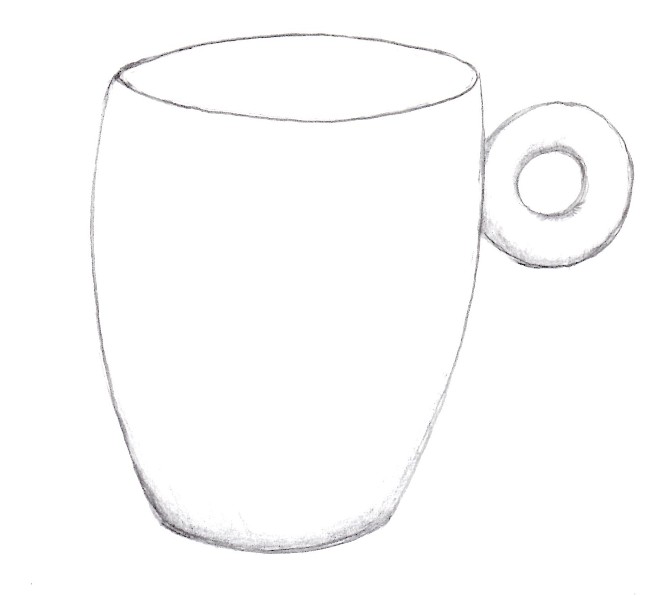
And the cups, because of their design, were practically unusable. The basic cup was a perfectly nice classic shape, wider at the top and curving down to a smaller base. It was the handle that was the problem. It was small and perfectly round, stuck onto the cup near the top. Think a donut clinging to the side of a pitcher. Or imagine Mickey Mouse with only one ear, and that a small one with a piercing that had gone horribly wrong.

If you care, you can see a photo of the cup at the website linked below, but here’s a rough sketch:

illy cup sketch

If you put your finger through the hole to pick up the cup, you couldn’t curl your other fingers beneath the handle for support without burning your knuckles against the side of the hot cup. If you tried to pick up the cup by the handle without that support, the weight of the cup would tip forward, spilling half the contents into your plate or your lap.

The only way to actually drink out of the cup was to treat it like a Chinese tea cup without a handle. This meant picking it up with both hands, carefully, at the top, so as not to burn your fingers.

The coffee shop advertised proudly that it served illy (not my typo; the “I” is not capitalized) brand coffee, and the cups obviously came from the coffee company, because “illy” marched proudly in red across the front of each one. When I took a look at the illy website, all became clear. The coffee cups aren’t merely vessels for drinking out of; they are art.

Here is the explanation, taken straight from the website: the illy company has “rethought” and “elevated” the coffee cup to “meld the sensory pleasures of coffee and art.” The company sells a variety of cups, with designs by a variety of artists, as an art collection. Buying one of these cups gives you an opportunity for “an experience that fully engages the senses and the mind.” The cup’s shape, created by an architect and designer, “was a full meeting of form and function: a vessel made to optimize diffusion of aromas and retention of heat, while establishing an entirely original tactile and aesthetic experience.”

Well, form and function may have met, but they obviously didn’t get along well. Apparently the designer was so focused on the aesthetic experience that he never got around to testing the cup to see whether an ordinary, non-artistic person in need of caffeine could actually drink out of one.

I have to admit, though, that there’s one way the cup design is a great success. Suppose you pick it up by the handle, and it tips forward and spills hot coffee into your lap, causing you to jump up, drop the cup, and utter several heartfelt expletives. Congratulations! You have just enjoyed “an experience that fully engages the senses and the mind.”

Categories: Fashion, Food and Drink, Living Consciously | Tags: , | 3 Comments

National What Day?

It wasn’t my fault, honest. Nobody told me in time. I didn’t find out until after breakfast that today was National Doughnut Day. By then, it was too late. I had already eaten a bagel.

Apparently, National Doughnut Day is more than just a marketing tool dreamed up by the likes of Dunkin’ Donuts or Krispy Kreme. It’s actually a marketing tool dreamed up by the Salvation Army back in the 1930’s.

Okay, that’s not quite fair. The day honors the efforts of Salvation Army volunteers who started serving coffee and donuts to soldiers in France during WWI. Their Salvation Army Huts represented a lot more than just a doughnut. The respite they provided must have been a blessing, and the women who made and fried all those treats became known as “Doughnut Dollies.” During WWII, the most widespread sources for coffee and doughnuts—thanks to the work of the next generation of Doughnut Dollies—were the Red Cross canteens.

Now that I know all this, I’m even sorrier to have missed the chance to observe National Doughnut Day. Though I guess there is still lunch. And midafternoon snack. And supper.

Or I could look ahead. I have some rhubarb in the freezer, just in time for June 9, which is National Strawberry Rhubarb Pie Day. Or, to think more broadly—in more than one sense of the word—June is also Candy Month.

There’s a special day for just about anything you can think of, and a lot of things you can’t imagine anyone thinking of. Yesterday, for example, was Hot Air Balloon Day. June 10 is Ball Point Pen Day, and June 13 is Sewing Machine Day. And today is also Gardening Exercise Day—a good thing, given all those doughnuts.

For anyone wanting to keep track of these things, you might check out www.daysoftheyear.com. It could help you avoid glaring mistakes like observing National Doughnut Day with an inappropriate bagel.

But I have a plan to make amends. I’m marking my calendar now. Next February 9, I’m having a doughnut for breakfast. Maybe two, since I missed out this year. February 9 is National Bagel Day.

Categories: Food and Drink | Tags: , , | 1 Comment

The Case of Grandma’s Stolen Stash

Oh, dear. There went another missed opportunity to collect some votes in the “most popular grandma” competition.

If only I had realized the potential earlier. The last time we traveled through Colorado, I could have stocked up on baking supplies. Then I could have made a nice batch of “Mary Jane’s special brownies” to share with the grandkids.

The way some grandparents in Greeley apparently did. Oh, not on purpose—at least not the sharing part. It appears that a few enterprising fourth-graders found Grandma and Grandpa’s pot-laced goodies. With a business sense beyond their years, the budding little entrepreneurs took the treats to school to sell.

The kids are facing disciplinary action. No charges are expected to be filed against the grandparents, who presumably have been punished enough by the loss of their legal but poorly hidden treats. The school district did send home a letter reminding parents and grandparents to secure their stashes better.

I should hope so. In addition, however, shouldn’t children be taught not to steal from their grandparents? When I was a child, my grandmother kept peppermints in her purse and Hershey bars in her dresser drawer. She did share, but only by invitation and on her terms. To the best of my knowledge, no grandkid ever dared to filch any. We knew we were expected to keep our mitts off of Grandma’s stuff.

As a grandma now myself, that expectation seems perfectly appropriate. But just to be on the safe side, I hereby make a solemn promise. It’s extremely unlikely that I will ever bake a batch of brownies with pot in them. If I ever do, though, I swear I’ll hide them well. No grandkids will ever get their sticky little fingers on pot-enhanced chocolate at my house.

Actually, it’s almost as unlikely that I will ever bake a batch of brownies containing nothing more powerful than cocoa. If I ever do, though, I swear I’ll hide them equally well. Some substances are just not meant to be shared with children.

Categories: Family, Food and Drink | Tags: , , , | 2 Comments

Driving Men to Drink

One of my close friends, a man of mature years, asserts that every woman he has ever met is only interested in one thing: getting men to drink more.

No, this isn’t some sort of gender-reversal seduction plot along the lines of, “Another glass of wine, my dear?” Sorry if any of you got excited there for a minute.

This is about drinking more water.

It’s a scientifically unproven but clearly observable phenomenon that women drink more water than men do. We’re the ones carrying water bottles in our cars and our bags, keeping carafes on our desks, and stopping at the kitchen sink for a quick one before we leave the house. When the server in a restaurant comes by offering “more water?” as a subtle hint (“You’ve been here for two hours, for Pete’s sake; would you just get out of here and let someone else have this table so I might make some decent tips this evening?”), we’re the ones who not only accept the refill but actually drink it.

Every time a man has some sort of health problem, then, whether it’s major or minor, most of the women in his life are likely to ask, “Are you drinking enough water?” And several men of my acquaintance would like to know why.

Well, I know why. And I am about to spill the secret. It’s breaking the women-only code to reveal this, though, so please don’t let anyone know I told you.

Yes, women think drinking more water is good for one’s health. Yes, we want the men in our lives to be healthier. But beneath those genuine concerns, which of course are as pure as bottled water from crystal-clear mountain springs, is a deeper plot.

You’ve noticed, I’m sure, that during intermissions at public events like plays and concerts, the lines at the women’s bathrooms are much longer than those at the men’s bathrooms. This is partly because, for reasons both physiological and fashionable, it takes women longer. It is also because more women, being the heavy drinkers that we are, need to use the facilities more often than men do.

Therefore, if more men drank more water, more men would spend more time standing in line for the men’s room. And fewer men would be leaning against the wall in the lobby, jingling their car keys and looking at their watches, waiting for their wives or dates to get back from the ladies’ room. There would be less eye-rolling and fewer impatient greetings of, “What took you so long?” Having stood in line themselves, they would know exactly what took so long.

There’s nothing like shared experiences to increase understanding and closeness in a relationship. This is the real reason so many women want their men to become heavier drinkers.

Better relationships through equal-opportunity imbibing: now there’s something to celebrate. I think we should all have another drink.

Categories: Food and Drink, Just For Fun | Tags: | 1 Comment

“Nobody But a Logger Stirs His Coffee With His Thumb”

Rocking a baby to sleep is one of life’s lovely little pleasures. Well, at least that’s true as long as said baby, not particularly interested in going to sleep, isn’t screaming its darling little head off.

Fortunately, this wasn’t the case the other morning with my one-year-old granddaughter. She was just a bit reluctant to settle down for her nap, so I sat down in the rocker and sang to her. For whatever reason, when I sing to little ones they seem to slip right into dreamland. Given my singing voice, my theory is that they do it in sheer self-defense. Never mind; if it works, it works.

In this case, it only took two times through “The Frozen Logger,” before she was sound asleep. I just sat for a little while, soaking in the pleasure of holding her and watching her beautiful little face as she slept.

During this meditative interlude, the song kept going around and around in my mind. “The Frozen Logger,” is a folk song by James Stevens that I learned from a recording by The Weavers. It has several qualities that make it a good lullaby. It’s a fun little story song, set to a waltz, so the words are easy to remember. It doesn’t have any inconvenient low notes or annoying high notes. And, most important, it has a lot of verses and can be repeated more or less indefinitely.

The longer I sat, though, the more I started to wonder about the song. Chiefly, whether it was really an appropriate one for a conscientious grandma to use as a lullaby. After all, it’s about a guy so tough he “stirs his coffee with his thumb.” Not only that, “if you’d pour whiskey on it, he would eat a bale of hay.”

Then I remembered how that classic lullaby, “Rock-a-Bye Baby,” ends. “When the bough breaks, the cradle will fall, and down will come baby, cradle and all.” Given the potential trauma to an infant psyche from this happy thought, I decided not to worry about mere bare-digit coffee stirring.

Then I got distracted by another thought. Suppose you have a cup of steaming hot coffee, fresh from the pot. Or you’ve just poured boiling water over a tea bag. There’s no way you would stick your thumb in that cup.

Yet some people have no problem whatsoever in drinking coffee while it’s still steaming. Or in sipping tea that’s been cooled from the boiling point by only a tiny splash of milk.

I’m one of those people. This is why I rarely order coffee in restaurants. It isn’t hot enough. So I gulp it quickly before it cools, and then the waitress comes by and fills it up again, and I have to drink that while it’s hot. And before I’ve finished my omelet I’ve had six cups, and I’m so full of caffeine that my hands shake for the rest of the morning, and if I tried to send a text, LOL would probably come out KIK.

What’s the explanation for that? Are our tongues—sensitive organs so capable of detecting subtle tastes that they can tell the difference between two brands of chocolate—really that tough? More to the point, are they really that much tougher than our thumbs? After all, thumbs, besides being one of the things making us human, are calloused, hard-working digits.

Maybe—to save others the trouble of pointing it out—I should just admit the most likely truth. Apparently, some of us exercise our tongues more than we do our thumbs.

Categories: Family, Food and Drink | Tags: , , , | 4 Comments

Little People at the Holiday Table

Sitting around the breakfast table on Christmas morning over our traditional homemade cinnamon rolls, scrambled eggs, and bacon, I had an epiphany. (Is it permissible to have an epiphany on Christmas Day, or does it have to wait until January 6? Maybe it’s okay as long as it’s an epiphany with a small “e.”)

Anyway, it happened about the time I was eating my fourth (or fifth or thirteenth—but who’s counting?) piece of bacon and watching the three newest participants in this particular tradition. The two-and-a-half-year-old, having rejected the unabridged dictionary as a booster seat, was on his knees in a chair of his own. The two littler ones, just past one and not quite one, were on their mother’s laps. They intercepted bites of egg with surprising tidiness and did their best to get a full share of the bacon. They seemed enthusiastic about the cinnamon rolls, too—though I did have some suspicions about my daughter’s request for a third one “because the baby ate all of the last one.”

And that’s when I had the small-e epiphany. “Oh my gosh. We’re going to need a kids’ table.”

One of the biggest blessings in my life right now is having two of my kids and their growing families living right here in Rapid City. And that means, one of these years, at family gatherings we will need an extra table for short people. A place where they can skip their green beans without anyone noticing, decorate their fingertips with black olives, and giggle a lot over conversations not meant for adult ears.

Just to be clear, in my experience the point of having a kids’ table isn’t to segregate squirmy small people with rudimentary table manners away from the good china and crystal. It’s more about squeezing people into the available space. At family gatherings when I was growing up, the kids were put at the kitchen table and card table because the dining room table, even expanded with all its leaves, would only hold 12 or 14.

It was usually fun at the kids’ table, of course. And sometimes educational. I remember one discussion about whether some red stuff in a little bowl was jelly or Jell-O. No one wanted to be the first to taste it. When someone finally got brave and tried half a spoonful, we still weren’t sure. (All these years later, I assume it must have been cranberry sauce.)

Still, I always felt I was missing out by not being at the adult table, because so many family members were and are such great storytellers. I loved hearing their stories, and every time I heard a burst of laughter from the dining room I assumed I had just missed one.

So at our house, when we do need a kids’ table, I hope we have room to put it at just the right distance from the adults’ table. It’s a delicate balance. They need to be far enough away so we can pretend we don’t hear or see what they’re doing. Yet I’d like them close enough so, if they want to, they can easily eavesdrop on our conversations. It’s just one more way of passing along the family stories. Especially, perhaps, the ones we don’t necessarily intend them to hear.

Categories: Family, Food and Drink, Living Consciously, Remembering When | Tags: , , | 1 Comment

Stop and Smell the Bacon

Bacon. It’s one of life’s fatty little joys. Especially when you have fresh tomatoes from your own garden and can combine the two for BLT’s.

That’s what we had for supper the other night. Well, actually, since I discovered at the last minute that we were out of lettuce, we had BT’s. Close enough. It’s the bacon and tomatoes that matter the most, anyway. (I briefly considered substituting spinach, but somehow BST’s just wouldn’t have been the same.)

Anyway, while I was cooking, I had one of those stop-and-smell-the-bacon moments of pondering, and the significant life question that crossed my mind was, “What in the heck is a rasher?”

As in a “rasher of bacon.” It’s one of those descriptions that shows up now and then, particularly for those of us who read British mysteries. But how much bacon is in a rasher?

Inquiring minds wanted to know. So, as soon as they had chomped down their BT and wiped the bacon grease off their fingers, inquiring minds went off to look it up.

Three dictionaries later, inquiring minds were confused. All three sources defined rasher as both A, a thin slice of bacon, and B, a serving of several slices of bacon. Apparently, a “rasher” could consist of several rashers. None of them knew where the term “rasher” came from, either. That was certainly enlightening.

At least most the other odd terms of weights and measures we use have some precision. Take “teaspoon” and “tablespoon,” for example. Any good cookbook will tell you that a tablespoon equals half an ounce and there are three teaspoons in a tablespoon.

Of course, that doesn’t explain why they have the names they do. When I was a kid, it never made sense to me that the spoons we put on the table at mealtimes were “teaspoons,” while the only time we used “tablespoons” for eating was when we had soup. Which is probably why we called them “soup spoons.”

It wasn’t until I got a little older and started reading British mysteries that I figured out some people used the larger spoons for eating and the smaller ones for stirring their tea. Today, while I am no longer confused if I see people actually using a tablespoon to eat something besides soup, I still don’t do so myself. And I don’t care who you are, using a tablespoon for ice cream is just not right.

Maybe it’s because they use large spoons at the table that the Brits measure their weight in “stones.” Or maybe it’s just that, when your money is “pounds,” you don’t want to confuse your net worth and your net weight. The dictionaries were not enlightening on this point. They did, however, inform me that a stone equals 14 pounds.

Now that’s a unit of measure any experienced dieter could get used to. Just consider the difference between, “I gained half a stone,” and, “I gained seven pounds.”

But whether you measure your weight in pounds or stones, I do know one thing. If you don’t want too much of it, don’t get rash with your rashers of bacon.

Categories: Food and Drink, Words for Nerds | Tags: , , | 1 Comment

Blog at WordPress.com.