Living Consciously

Driving Across Flyover Country

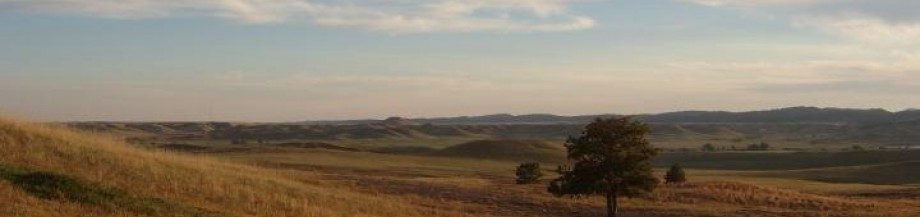
Traveling from the western end of South Dakota to the eastern end of Nebraska requires a long day's drive across a lot of prairie. After a few hours, it's the kind of trip that can make you start to reconsider the price of airline tickets.

I've made a lot of trips across this land, most of them driving, but a few in a small plane as well. It's fascinating to see the subtle beauty of the land from the air, whether it's the open spaces of West River ranch land or the patchwork fields of East River farm land. That beauty is easy to miss if you're traveling in a jet at 30,000-something feet. I suppose it's understandable that this part of the world is so easily dismissed as "flyover country."

A lot of people were flying over it too. Driving south in the late afternoon, we watched a sky filled with contrails, clear evidence of the amount of east-west traffic. At one point we saw two jets going east and two others going west on what looked almost like collision courses. They sped past each other, two of them crossing each other's trails to temporarily mark the spot with an X. A short time later, a single nonconformist bisected their fading paths from north to south.

As the sun set, a third of the vast prairie sky glowed with orange, violet, and turquoise, giving us an evolving light show for half an hour. More contrails stitched rows of white and deep purple across the layers of high, streaky clouds.

None of the travelers in the jets tracking so temporarily through the sky could have seen us so far below. They wouldn't have noticed, either, the new motel being built in the tiny town of Dallas that a recent article at SmartMoney.com dismissed as a place "two hours from the nearest major airport" where you can't even "get a decent bite to eat." They wouldn't have seen that the new motel was right beside a thriving steakhouse. Nor would they have seen the giant towers of the grain elevator that makes Dallas so important to the local farm economy.

They wouldn't have seen the birds, either. A long-dead cottonwood tree beside a stock dam provided the perfect perch for a bald eagle to pose in a stately manner befitting its status as our national symbol. A lake bed filled with dried grass and milo stubble must have been a prime hunting ground, because half a dozen hawks and golden eagles were circling it.

A rooster pheasant erupted out of the grass as we drove by. He must have seen the predators in their lunchtime holding pattern, because he dived back into the cover even faster than he had started out. He wasn't going to become someone's meal this day. He knew the dangers of living in flyover country.

Categories: Living Consciously | Tags: , , , | Leave a comment

Don’t You Turn My Brown Eyes Blue

"If you read it on the Internet, it ain't necessarily so." That's my motto when it comes to judging the veracity of stories that get passed along online. From outrageous political or economic "facts" to heartwarming stories about sick children, brave rescues, or baby ducklings being adopted by mama mountain lions, my attitude ranges from healthy skepticism to plain old-fashioned cynicism.

Unfortunately, the following story showed up in enough reputable news sites that it appears to be true. A certain Dr. Gregg Homer claims to have developed a laser procedure that will permanently turn brown eyes blue by removing the outermost layer of pigment. It may possibly come as no surprise that he is from that Silicon Valley of cosmetic surgery, southern California.

Dr. Homer, by the way, is a former entertainment lawyer and law professor who has a science degree from Stanford but is not an ophthalmologist. Maybe that's why I have trouble believing his assurances that this procedure wouldn't cause any inconvenient side effects. Like infections, say. Or increased risks of glaucoma or macular degeneration.

What was truly discouraging, though, as I skimmed through news reports on this story, was the number of brown-eyed people who appeared to be interested in this procedure. Dr. Homer's own estimate was 17%. It's easy to disregard that number as biased, of course. Still, comments on several of the stories included a surprising number who thought changing their brown eyes to blue was the greatest idea since Botox.

Until reading those comments, I didn't realize blue eyes were supposed to be sexier and more beautiful than brown eyes. Who knew? Here all these years I thought my lack of dates in high school was due to my shyness and lack of social skills.

Or maybe the Old Blue Eyes wannabes have the same mindset as Dr. Homer, who was quoted in a couple of reports about the eyes being "windows to the soul." In his view, light-colored eyes have the advantage of being less opaque and therefore are more "open" windows.

Maybe so. Having been lied to over the years as effectively by blue-eyed children as brown-eyed ones, I have my doubts.

As the sixth grandchild in my extended family, and the sixth girl, I was told as a child by my grandmother that "the only reason we brought you home when we found out you were a girl was your pretty brown eyes."

Setting aside the various layered messages in that statement, I'll just say this: if brown eyes were good enough for my blue-eyed grandmother, they're more than good enough for me. Opaque or not, I'm keeping mine in their original condition. If I want to invite you to look into my soul, I'll let you know.

Categories: Living Consciously | Tags: , , , , , , , , | 3 Comments

The Spartan Boy, the Fox, and the Tulip Bulb

The ancient Spartans probably would be proud to know that we use their name today as a synonym for self-discipline and avoidance of luxury. They might be less pleased with our opinion of their child-rearing philosophy, which was a cross between Attila the Hun and Super Nanny on steroids.

Their nurturing attitude toward the young is summed up in the familiar story about the Spartan boy and the fox. As part of their rigid training, boys were taught to steal to supplement their meager food rations but were severely punished if they got caught at it. This boy had stolen the fox, intending to eat it. In danger of discovery, he hid the fox under his clothes, where it started gnawing at him. He kept the animal hidden and endured the pain without flinching, until the fox ate its way into his vital organs and he died.

Just imagine what reality television could have done with this. "Desperate Schoolboys." "Suffering With the Stars." "Are You Tougher Than a Fourth Grader?"

For centuries, this Spartan boy was held up as a role model for toughness, honor, and self-control. Well, maybe. I think his real motivation was a little different. Here's why.

One day when I was about seven or eight, I discovered a pile of little onions in the large round planter in the middle of the front yard. It didn't occur to me to wonder why my mother or grandmother would have pulled onions from the garden and left them in the yard rather than taking them into the house.

I didn't especially like onions, but in one of the small spasms of recklessness that occasionally disturbed the timidity of my childhood, I decided to eat one. It didn't taste at all oniony. In fact, it didn't have much flavor at all. About the time I swallowed the last bit, I realized, with that sinking feeling you get when you recognize you've made a mistake precisely one second too late to take it back, that I had eaten a tulip bulb.

I went into the house and asked my mother, with great casualness, whether tulip bulbs were poisonous. Probably, she said. She may have thought she was discouraging me from nibbling on things that shouldn't be nibbled. It obviously didn't occur to her that I was asking after the fact. Maybe I was a little too casual.

For the next couple of days, I worried. I waited for symptoms of acute tulip poisoning to show up—tummy aches, dizziness, my tongue turning black, paralysis, death, whatever. I didn't sleep well. I may have even lost my appetite.

What I didn't do was tell my mother or anyone else that I had eaten something that might possibly be poison. Thankfully, I never did get sick. If I had, I hope I would have been brave enough to fess up. But I walked around for a couple of days wondering whether I was going to die—and I was too embarrassed to say anything. That's how ashamed I was of being too dumb to know the difference between an onion and a tulip bulb.

That Spartan boy? He was tough and self-disciplined, all right. But I think what really made him hide his suffering was fear that someone would catch him making a mistake. In part, that kid died of shame.

Categories: Living Consciously, Remembering When | Tags: , , , , | 1 Comment

The Green Leaves of Summer

When did it get to be September? Apparently I wasn't looking. But I just turned my back for a few minutes, I swear. A week ago, we traded the 95-plus temperatures here for the 100-plus temperatures of southern New Mexico. It may be, as everyone there points out, a "dry heat," but it would be easier to live with if it would cool off at night enough to at least consider opening a window.

While we were gone, summer not only opened its windows, but carelessly left the back door ajar as well, and fall began creeping in. Or at least it started sniffing around the opening. It was chilly here this morning. Summer, still lush and arrogant with this year's abundant rain, just hasn't noticed yet that its days are growing shorter.

Neither have our tomato plants. It's been almost six weeks since they were stripped of all their leaves and most of their fruit by a hailstorm. They were nothing but battered stalks that obviously needed to be pulled up and tossed onto the compost pile.

Before I got around to cleaning up the mess the hail had made of them, though, the plants started to recover. A few leaves started growing back, and then a few more, and now the plants are almost as tall as they were before the hail, vibrant with new green leaves and covered with blossoms.

I don't have the heart to tell them that all their hard work is in vain. There's no way they can produce another crop before the first hard frost. It's like seeing someone get badly injured in a car accident, who survived surgery and has been working furiously at rehab and making a great recovery—only you've seen this movie before and you know they're going to walk out of the hospital and get run over by a garbage truck. I can see what's going to happen, but I can't do a thing to stop it.

Meanwhile, out on the deck, the two pots of pansies that also got hit by the hail are still blooming. The first hailstorm smashed them into a quarter of an inch of green mush. About half the plants didn't survive. Within a week, however, battered stems with a few tattered leaves had managed to stagger more or less upright and put out defiant buds. Two weeks later, the second hailstorm knocked them around. Beaten but unvanquished, they were blooming again within a few days. They are blooming still, their vivid yellow and purple making the most of every day between now and the first freeze.

In her first draft of Gone With the Wind, the name Margaret Mitchell chose for her heroine wasn't Scarlett O'Hara. It was Pansy. I can understand why.

Fall may be just around the corner, but its time hasn't quite come yet. It can wait its turn.

Categories: Living Consciously, Words for Nerds | Tags: , , , | Leave a comment

“There’s a Hole in My Bucket”

A bucket list. Maybe you have a real one, written out and posted on your refrigerator. Or maybe you just have a few things in the back of your mind that you really want to do "someday." ("See the Eiffel Tower by moonlight." "Visit Machu Picchu." "Go skydiving." "Learn to play the banjo." "Use 'quartzite' for a triple word score in Scrabble.")

Either way, it's probably a good idea to have some sort of list of things you want to do before you kick the bucket. And an even better idea, of course, to actually do them.

But here's something else that's also a good idea: a "hole in your bucket" list.

Some of the things on your bucket list might not belong there anymore. Maybe you wanted to do them once upon a time—or thought you did. But by now, one way or another, they're just not worth the trouble. It might be time to let those things just slip through a hole in the bottom of your bucket.

Maybe you've figured out that some items on your list are too risky or too dumb. (Bungee jumping, anyone?) You might be like the rancher who said he wanted to be a bull rider "until I got older and my brains came in."

Maybe some things on your list really aren't your dreams at all, but belong on someone else's bucket list. If your spouse has always wanted to go sky diving or canoe up the Amazon or trek through the Gobi Desert, you don't have to want to go, too. You can wave goodbye with a big smile, then enjoy looking at the pictures afterward.

There might be items on your list that seemed like a good idea at the time, but on second or third thought, you really aren't that interested. When I visited the Grand Canyon a decade ago, a hike to the bottom sounded like fun. Now, not so much. By now I've figured out the drawback to the whole plan. The natural consequence of hiking to the bottom is that you have to hike back up to the top.

Sadly, it might be too late for some bucket list items. If you're a person of mature years, say 59 or 67, you probably aren't ever going to realize that long-held dream of dancing with the Rockettes or playing tight end for the Green Bay Packers. (Let's face it—no matter who you are, "age 67" and "tight end" just don't belong in the same sentence.)

If there are things on your bucket list that won't keep, start actively planning to do them sooner rather than later. And while you're at it, take a close look at your list. It might be time to let some things fall through the hole and disappear. Letting go of goals that no longer fit makes more room for new ones.

It also helps you refocus on long-held goals that really do matter to you. One of these days, there's got to be a place to play "quartzite" and get that triple word score.

Categories: Just For Fun, Living Consciously | Tags: , , , , , , , , , | 2 Comments

The Freedom To Be Independent

"I will celebrate freedom by shooting off my fireworks at whatever time I please, anywhere I please. And I will leave the leftovers where they lay, as this is still America, the land of the free."

This was one of the "Page Too" comments in the Rapid City Journal on July 5. Just to give this person the benefit of the doubt, it's possible that the comment was intended as sarcasm.

I hope so. If not, the comment is confusing freedom and independence.

The Fourth of July isn't "Freedom Day," it's "Independence Day." It celebrates our emancipation from the mother country, our choice to make our own decisions and govern ourselves. It marks our adulthood as a nation.

Freedom to do whatever you want with no consideration for your neighbors, and to let someone else clean up your mess, is the freedom of a child. As adults, we may look back wistfully on what we see as the carefree days of childhood. No job to go to, no mortgages or money worries, no adult responsibilities, no need to worry about anyone except ourselves. That "carefree" existence has a certain level of freedom, but it certainly is not independence.

True, children are free to be irresponsible because their parents take care of their needs. Their parents also control where and how they live, what they eat, what they wear, when they go to bed, and whether they get to spend eight hours a day playing video games.

It is dangerously shortsighted to define "freedom" as the right to do whatever we want, whenever we want, and to let someone else be responsible for cleaning up the mess or paying the bills. That may feel like freedom in the short term, but it is the exact opposite of independence. Insisting on such illusory freedom is claiming the "right" to be taken care of like a child—which is a certain route to losing freedom altogether.

Being independent, on the other hand, is defined by Merriam Webster as "not subject to control by others: self-governing." Independence is the right to accept responsibility for ourselves and interact with those around us with the mutual respect of equals.

This year I spent the Fourth of July in Lincoln, Nebraska, where unrestricted fireworks were allowed. On the evenings of both July 3rd and July 4th, the whole town was lit up with amateur fireworks displays. Street corners were riotous with sparklers, bottle rockets, mortar shells, flaming hot air balloons, and the odd exploding watermelon. It was freedom, all right—noisy, dramatic, exciting, beautiful, occasionally obnoxious, and more than a little frightening.

And, of course, messy. The next morning, when I went for a walk, the streets were covered with scorch marks and littered with cardboard, fuses, and other remnants of thousands of fireworks. A few places had been cleaned up, and I saw two men busy with brooms and garbage cans. On many more street corners, though, the celebrators had obviously chosen to "leave the leftovers where they lay."

In front of one house, three little boys aged about six to ten, were out with a broom, a shovel, and a trash can. They were cleaning up their mess with considerably less enthusiasm than they must have shown for shooting off the fireworks the night before. They probably didn't think of themselves as fortunate.

Yet, whether they appreciated it or not, they were being taught an essential lesson. They were learning the difference between childish freedom and grown-up independence. It's an important distinction for each of us to practice as Americans, not just on Independence Day, but every day.

(This column was first published in the Rapid City Journal as a guest editorial on July 9, 2011.)

Categories: Living Consciously | Tags: , , , | 1 Comment

The Almost Outstanding Graduate

"Pomp and Circumstance." Graduation simply wouldn't be graduation without it. At least I hope that's still the case because, trite or last-century as it may be, the grand sweep of that music still moves me right down to my toes.

Actually, the music we think of as "Pomp and Circumstance" is only one section, "Land of Hope and Glory," from the first of six "Pomp and Circumstance" marches written at the beginning of the 20th Century by British composer Sir Edward Elgar. It was first used as a graduation recessional at Yale in 1905, and since then hundreds of thousands of graduates have done their best to keep their mortarboards level and move at a pace appropriate to its stirring dignity.

It would be fun sometime to hear the entire suite of marches at a concert, though during the "Land of Hope and Glory" section it is probable that a large portion of the audience would be irresistibly driven to rise from their seats and march solemnly toward the stage in alphabetical order.

Maybe my emotional reaction to "Pomp and Circumstance" stems from my own high school graduation, though I don't consciously remember the music. What I do remember is processing in, seventy-something of us, two by two, from the back of the city auditorium and down the center aisle through the rows of seats crammed with relatives and friends.

Just as we had rehearsed, when we reached the front each pair separated to file in opposite directions and take our places, standing in front of the seats that were reserved for us. Being an "S," I was toward the end of the pack, and my assigned seat happened to be at the aisle end of the row. I reached the designated point, turned toward the row of chairs—and realized I didn't have one. Someone had counted wrong, or someone in the crowded auditorium had filched a chair.

Behind me, the rest of the graduates filed into the last row. Up on the stage, the minister began his invocation. Standing with my head dutifully bowed just enough so my mortarboard wouldn't slide off, I was quietly panicking. As soon as he finished, I knew he was going to say, "Please be seated," and everyone would. Everyone except me, who would be left the lone graduate standing, the humiliated focus of hundreds of eyes.

Some seniors, self-confident class president types or debate champions or drama club lovers of the spotlight, might have been able to pass such an incident off with élan or even enjoy the attention. I was not one of those students.

Before the pastor got to the end of his invocation, though, I felt something nudge the back of my robe. Miraculously, a chair had appeared behind me. When we were told to be seated, and in uneven blue-robed unanimity we sat, I had never been so grateful to settle onto a hard metal folding chair.

After the ceremony, I learned that a neighbor, the father of one of my classmates, had noticed my predicament from his seat near the aisle a few rows behind the graduates. During the prayer, this burly, six-foot-plus man had sneaked forward with his own chair and placed it behind me. Knowing him, he gave the audience a big grin as he went to stand in the back of the room.

I hope I thanked him properly. As inarticulate and shy as I was at the time, I probably wasn't able to let him know how much his embarrassment-sparing gesture meant to me. And now, even though I've remembered it with gratitude for all these years, he's gone and it's a decade too late to tell him in person.

Thank you, Lyle. Bless your kindness and your quickness. I think about you every time I hear "Pomp and Circumstance."

Categories: Living Consciously, Remembering When | Tags: , , , | 1 Comment

Born to be Mild

Bungee jumping? No thank you.

Roller coasters? Did that once, thanks. Once was once too often.

There's an episode of Star Trek: The Next Generation in which Captain Picard, having learned about some consequences of a youthful misadventure, is regretting what he sees as his character flaw of recklessness. He is taken back through his life to explore how it might have been if he had taken fewer risks. It turns out he would have still ended up on the Enterprise, but as a low-ranking, undistinguished member of the crew. The risk-taking he had seen as a flaw was part of what gave him the ability to command a starship.

Unlike Picard, when I look back I don't regret my past reckless behavior. Quite the opposite. As a child, I believed that rules were meant to be obeyed, boundaries to be respected, and lines to be colored inside. Not only was I rarely the one suggesting anything adventurous, I was often that annoying kid warning the others that they were going to be in big trouble.

This was less about respect for the rules, actually, than it was about being chicken. I was simply born to be cautious. On the very few occasions I did let peer pressure lure me into wilder behavior, I usually lived to regret it.

Like the time at church camp when I was a teenager. Everyone else was doing it. (Well, as is usually the case, not quite everyone. Several people were doing it, including a boy that I wanted to impress.)

No, not drugs. Not smuggling pine cones into the counselors' beds. Not smoking cigarettes or necking out in the woods. A few kids very likely did those things, but they didn't tell me about it.

Someone had come up with the bright idea of putting a plank across a log to make an impromptu teeter-totter. The smaller person, aka the girl, would stand on one end. The larger person, aka the guy, would jump onto the other end, sending her into the air. Her hair and sometimes other parts of her anatomy would bounce in an appealing manner, and she would squeal and giggle and come down more or less on her feet.

It looked like fun—sort of. One of the boys doing the jumping was the one I was hoping to impress. I didn't want to look like the chicken I really was. Even though my sensible side tried to talk me out of it, I allowed myself to be coaxed onto the short end of the board.

He jumped onto the other end. I went flying. If my hair bounced in an appealing manner, I didn't have time to notice before I tumbled sideways and the ground came up and hit me.

My wrist hurt and started to swell. The camp director insisted on taking me to town for an X-Ray. Instead of playing my guitar at the campfire sing-along that night, I spent the evening in the emergency room finding out my wrist wasn't broken. They sent me back to camp with an ice pack, which soothed my bruised arm but didn't do much for my bruised pride.

In the years since, I've become far more adventurous in a lot of ways. I've learned to take a few more risks—at least of the emotional and social kind. But physical? No thanks. I still don't do carnival rides that fling you around like Raggedy Ann on speed. I don't stand at the edges of cliffs when I'm hiking in the woods. I take my vitamins, eat my vegetables, use sunscreen, keep my gas tank at least half full, and always fasten my seatbelt.

Maybe that explains why no one has ever put me in command of a starship.

Categories: Living Consciously, Remembering When | Tags: , , , , , | 4 Comments

Sniffing Out a Good Book

Kindles. Nooks. As the marketing experts who came up with them would be very pleased to know, the names alone tend to make you want to curl up in a cozy corner by the fireplace with a good book.

I don't have an ereader yet, not because I don't want one, but because I haven't quite managed to decide which one to get. In the meantime, I've been reading some of the discussions for, against, and about ereaders and ebooks in general.

Some readers are passionate advocates for ebooks, some are lukewarm about the new technology, and some vow they will give up their paper books only when their last well-worn copy of "Twilight" is pried from their cold, dead fingers.

One aspect of those discussions baffles me. There are plenty of people who say one of the reasons they enjoy paper books is the way they smell (the books, not the readers). My daughter, who admits to being one of these people, says it's the glue. I suppose I should be grateful that book-binding glue is the only kind she sniffs.

I don't get it. It isn't that I'm olfactorily challenged. I savor all sorts of favorite smells—not to mention being sensitive to all sorts of smells that make me sneeze. But I don't sniff books. I don't think of them in terms of odor. I'll walk into a flower shop, a bakery, or a leather shop, inhale, and say to myself, "Ummm, it smells so good in here." I only do that with bookstores if they have coffee shops in them.

Of course, I don't get the thrill of that famous new car smell, either. Once, when my late husband's construction company had just bought a brand-new crew cab pickup, we drove it up into the hills for a family picnic. By the time we got there, I had a headache and the three kids in the back seat (including my daughter the book-sniffer) were all getting sick from the smell. Maybe the new car smell is more appealing in a luxury SUV with leather seats. Or maybe I've just never learned to appreciate it because I've never bought a new car.

Maybe that's my problem with books, as well. I don't appreciate the aroma because I don't buy a lot of new ones. Sometimes I browse in second-hand bookstores, which do have a distinctive smell, just like second-hand clothing and furniture stores do. It's easy to identify but hard to describe—a combination of musty basements, dusty attics, and closed-off rooms that haven't been aired out in a long time. Add accents of stale cigarette smoke and old perfume, and you have a definite aura that says, "other people's old stuff."

Mostly I get books from the library, and I have to admit a few of them have odors of their own. Cigarette smoke, sometimes, or coffee, or perfume. Once in a while it's strong enough to bother me, but usually I don’t pay much attention.

Apparently I don't care if a book smells like new paper, someone else's attic, or even new electronics. What I do care about is the smells, sounds, tastes, and emotions that skilled authors create. Smell the paper? Never mind. I'm too busy sniffing out the story.

Categories: Just For Fun, Living Consciously | Tags: , , , , , | 1 Comment

Late-Breaking News Flash

Hold on! News flash! Stop the presses!

Oh, wait, this is the Internet. Never mind the presses.

But make room, anyhow, for an important piece of late-breaking news that came in just at this week's publication deadline. Mackenna Marie has arrived.

She was born at 5:11 a.m. on January 21, weighing in at eight pounds, one ounce. When a lady is brand new, everybody wants to know how much she weighs. It's only later—after she's old enough to talk, maybe—that it's nobody's business but her own.

My morning started with a phone call letting me know Mackenna was here, a beautiful baby with all her fingers and toes and everything in perfect working order (including her lungs—I could hear her over the phone).

After a second cup of tea to celebrate, I went off to Curves for my usual Friday workout. Of course, I shared the good news. I'm sure the breathlessness of my account was due strictly to excitement rather than exertion as I huffed and puffed around the circuit.

Since all the other women working out were also grandmothers, it was the perfect place to celebrate. We agreed that grandchildren are wonderful and graciously allowed each other to take turns recounting the virtues of our own. We were jointly pleased at the shared hands-on parenting of today's young fathers. We appreciated the blessings of becoming good friends with grown daughters. It was an exercise in enjoying families as much as fitness.

By the time I got home, Mackenna's picture was already up on Facebook. She is, of course, beautiful, and no, she doesn't look anything like Winston Churchill.

Stop the Internet for a nanosecond and take note, everyone. Mackenna just joined the extended family of the World Wide Web.

Categories: Family, Living Consciously | Tags: , , | 1 Comment

Blog at WordPress.com.