Living Consciously

The Coin-Operated Time Machine

I went time-traveling yesterday—visiting both the past and the future. I had a fellow traveler, my daughter, and our time machine was the Dew Drop Laundromat.

No, I didn’t climb into a dryer and go spinning off into the past or the future. My body stayed right there in the plastic chair between the first and second rows of coin-operated washing machines.
It was my mind that went traveling.

Just being in the laundromat took me back to those years, well before my daughter was born, when doing the laundry meant stuffing everything into a couple of big baskets and loading it into the car, trying to remember every time to bring along the detergent and the dryer sheets. The memories came back vividly: The sense of impatience, feeling as if I were wasting time as I waited around for the machines to finish. The steamy air, scented with soap and fabric softener. The difficulty of concentrating on a book amid the noise of the machines and the distraction of the inevitable shriek of little kids running back and forth and climbing on the tables. The tinge of discomfort over folding my underwear in public. The secret antagonism toward the other customers, competitors who might get to the empty machines first. The relief of getting home with everything clean, dry, and folded, knowing I wouldn’t have to do it all again until next week.

That was my trip back into the past. It was a brief ramble, completely untouched by nostalgia, that sent me home with a strong urge to dash downstairs and hug the washer and dryer.

My trip into the future was even shorter, but it was far more unsettling.
This visit to the laundromat was my daughter’s chore, not mine, a chance for us to spend some time together while she got her laundry done. She was the one who knew how many quarters the machines took and how long their cycles lasted. She knew where to get change, where the bathroom was, and that the tentatively friendly resident Chihuahua’s name was Amber. I was merely the helper. I was the one sent to the counter to turn a ten-dollar bill into a roll of quarters, the one asking, “Which load do you want this shirt in?”

Being the subordinate in this way, watching my capable and confident daughter who has recently become so grown-up, I got a glimpse of what our relationship may be like in another 25 or 30 years. For just a moment, it felt as if our parent/child roles were reversed.

I didn’t entirely like it. My daughter tells me that when I get old she wants me to come and live with her so she can take care of me. That loving concern pleases me greatly. That doesn’t mean I’m in any hurry to take advantage of it.

Right now I’m in a wonderful position with my young-adult kids. I still have plenty of “mom” status when it comes to giving them support, encouragement, and (solicited—usually!) advice. At the same time, I don’t have to cook for them, bug them to clean their rooms, wait up at night for them, or pay their dental bills. I like that position. I’m free of the responsibilities of day-to-day parenting, yet I’m still respected as “Mom who can help take care of this.”
I don’t look forward at all to giving that up in favor of being “Mom who needs to be taken care of.”

Maybe the wiser course is not to look forward to it. Maybe I should limit my time traveling and focus on enjoying the relationship I have with my kids in the here and now. Maybe it’s a good idea to remember that sometimes the laundry is just the laundry.

Categories: Living Consciously | Leave a comment

The Wisest Words

Communication is the art of using the right words in the right way. Or not. Sometimes good communication means knowing when not to say anything at all.

One day a few years ago I answered the phone to hear a hesitant little voice. “Mom? Um, well, um, I accidentally threw away my retainer.” My daughter, calling home at lunchtime on the second day of fourth grade. “I forgot and put it in the garbage with my lunch sack, and they already took out the trash from the lunchroom. Will you come help me look for it?”

My first reaction was to launch into the standard lecture. You know the one. It starts with, “How could you be so careless?” and ends with, “Do you know how much we paid the orthodontist for that thing?”

Amazingly, on this occasion I managed not to say all those things. I did sigh—just once. (An experienced mother can get an amazing amount of guilt and exasperation into one sigh.) Then I said, “I’ll be there in a few minutes.”

When I got to the school, Ray, the custodian, said cheerfully, “Don’t worry, this happens all the time. We’ve never lost one yet.” He put on disposable plastic gloves, handed us each a pair, and we started digging through the garbage. The retainer was in the second bag, covered with chocolate milk and a bit sticky, but good as new after a thorough washing. With great relief on both sides, I went home and my daughter went back to class.

You might think I was able to stop myself from scolding my daughter because I’m naturally a patient person—or because I’m so wise that I usually think before I speak. I’d love to have you think that. It would be wonderful. Unfortunately, it wouldn’t exactly be the truth.

The real reason I was able to keep my mouth shut was because of something that had happened to me a few weeks earlier.

I had an appointment at my doctor’s office. When I got to the clinic, I parked in a space in the middle of the parking lot. There was no curb there, just one of those concrete dividers about four inches high and four feet long. When I came out after my appointment, I got into the car to leave—and started to drive forward instead of backing up. I got one front wheel over the concrete block that I had forgotten was there. There I was, with one wheel jammed against the far side of the divider and the other jammed against the near side. I was stuck. Thoroughly stuck. Humiliatingly stuck.

There are words that are just right for such an occasion. I said a couple of them, with feeling and emphasis. Then I took a deep breath, dug out my cell phone, and called my husband. “Um, I did something really dumb and got my car stuck. Will you come help me get out?”

He showed up about fifteen minutes later. He didn’t say, “How on earth did you manage to do something so stupid?” He didn’t laugh at me. He didn’t even sigh or roll his eyes. He just jacked up the car, backed it off the barrier, made sure it wasn’t damaged, and sent me on my way.

I was very grateful for what he did to free my car. I was even more grateful for all the things he didn’t say.

Much of the time, the trouble we get into is at least partly our own fault. We forget something, we get careless, or we make a mistake. Quite often, we need a little help to get out of whatever fine mess we’ve gotten ourselves into. What I’ve learned over the years is that sometimes it’s my turn to come to the rescue, and sometimes it’s my turn to be the one who messes up. In the long run, it probably comes out more or less even.

If I can remember that, it’s easier not to say all those scathing words that come so easily to mind when it’s someone else’s turn to be careless. Yes, we all need to be responsible for our actions. Yes, we need to fix our mistakes. Yes, we need to learn not to make the same ones again. And it doesn’t help us a bit to have somebody else point out what an idiot we’ve been. We already know that. A chewing-out that makes us feel dumber than we do already is neither kind nor useful.

When it’s your turn to be the rescuer, try to remember all the times you’ve been on the other end of the predicament. Take a deep breath. Count to ten. Go hide somewhere and rant or laugh if you need to. Then show up and shut up. Whether the person who messed up is your kid, your employee, or your spouse, give them the help they need, but skip the scolding. They’ll learn the lesson perfectly well without your rubbing it in, and both of you will be happier.

Sometimes the wisest words are the ones we never say.

Categories: Living Consciously | Leave a comment

Tomato Anticipation

Gardening, like second marriages, is often a triumph of hope over experience. It certainly is that for me, every spring. Witness the fact that it is now mid-March in South Dakota, and I have just planted tomatoes. In peat pots on the kitchen table, of course—I may be a cockeyed optimist, but that doesn’t mean I’m dumb.

As a gardener, I have become a specialist. Oh, I tried diversification for a couple of years. I spaded, mulched, watered, fertilized, and weeded with energy and concentration. My harvest was a couple dozen stunted ears of sweet corn, a few heads of bitter broccoli with a high protein content (think cabbage worms), a few cantaloupe killed prematurely by vine-munching grasshoppers, and a handful of mediocre cucumbers. But I did succeed in growing tomatoes—with that rich, red-ripe flavor that makes their supermarket counterparts taste like inadequately-ripened styrofoam.

By now, tomatoes are the only thing I plant. I always start them early from seeds instead of waiting to buy bedding plants, because every year I indulge in the fantasy of eating fresh tomatoes by the end of June. One year, indeed, we might have done exactly that if it hadn’t been for that early summer hailstorm. So the possibility remains, strong enough to persuade me into buying fresh potting soil, peat pots, and seeds every March.

I carefully fill each pot, then tuck three tiny, dry tomato seeds into each one. It is incredible to me that each one holds inside its desiccated self the potential of a sturdy plant, several feet high, bearing an abundance of fruit. Later, assuming they all sprout, I will have to choose the strongest-looking plant in each pot and ruthlessly pull the other two, a procedure that always gives me a pang.

Remember in kindergarten or first grade when you got to plant a couple of seeds in a paper cup or a small glass jar? Remember the sense of anticipation as you watered the bare dirt and checked each day to see if anything was coming up yet? And then all at once, like magic, there it was—a tiny green shoot. Then with amazing speed, maybe even by the next day, tiny leaves had unfolded. Then more leaves appeared, and the bean or marigold or whatever it was grew and thrived—at least until you took it home for Mother’s Day and forgot to water it, and it drooped over the side of the cup and died.

Every year, as I carefully plant my tomatoes and gently water them and set them in a sunny window, I feel the same sense of awe and anticipation that I remember from first grade. That is why I have become a gardener—albeit a fumbling and often unsuccessful one. Because, much as I love the taste of fresh tomatoes, gardening for me is less about harvesting than about planting.

It would be different, of course, if we depended on my garden for significant portions of the winter’s food supply. Because we don’t, I have no need to plant seriously and practically. My garden is a small indulgence in one corner of our generous yard. It’s a place I can reacquaint myself with earthworms and dirt under my fingernails, a place to savor the smell of fresh warm dirt and the feel of the spring sun on my back and the satisfying labor of digging. Each year it is a tangible expression of hope and anticipation.  Each spring it is a chance to start over.

And, who knows, this just might be the year that I celebrate my June birthday with a fresh, ripe tomato from my garden.

Categories: Living Consciously | Leave a comment

Civility and Seven-Bean Soup

“Mind your manners. Being polite never hurt anybody.”

Oh, yeah? I beg to differ.

Some years ago, as a divorced mother of two kids, I began dating a man who was also divorced. Early on, when we were both still trying to impress each other, he invited my kids and me over for dinner at his house. He served us seven-bean soup.
There’s nothing complicated about this stuff. It comes prepackaged with seven kinds of dried beans, including ordinary white beans, a couple of odd-looking varieties with spots, and of course the infamous limas. It has spices and seasonings all tucked up in their own little packet, so all you have to do is dump everything into a pot, add plenty of water, and cook it. It’s an easy meal for a busy single parent.

Mike served up the soup with a flourish, and after the first couple of bites he asked me what I thought.

First of all, I don’t like beans. I eat them on occasion, but even though I know they’re good for me I simply cannot bring myself to appreciate them. The taste is okay; it’s the texture I have trouble with—that mixture of graininess and mush that sort of grows in your mouth until you swallow it. To make matters worse, Mike’s seven-bean soup hadn’t been cooked nearly long enough. Some of the beans were still crunchy, and some of them squeaked horribly between my teeth when I bit into them, and the whole mess hadn’t had a chance to simmer until the flavors blended, which is one of the secrets of good soup, bean or otherwise.

But Mike was looking at me expectantly from the opposite end of the table. He had already made it clear that, as a single dad, he was proud of his cooking ability. I didn’t want to hurt his feelings. I didn’t want him to be mad at me. I wanted to be polite.
So I gulped down my mouthful of crunchy bean soup and lied through my teeth. “Oh, yes, I like it. It’s really good.”

Meanwhile, my kids were poking their spoons around in their soup and eating crackers. Mike’s son, who must have been used to the stuff, was eating doggedly. And Mike was beaming. His seven-bean soup was a success.

Now all of this might not have mattered a great deal—one bad meal, one polite lie, one batch of peanut butter sandwiches for the kids when we got home. But Mike and I kept dating for a while. Every now and then the kids and I ate dinner at his house. And almost every time he served us seven-bean soup.

Trapped by my own misplaced manners, I had to eat the stuff and pretend I liked it. My kids, more honest than diplomatic, never managed to choke down more than a few bites and gained undeserved reputations as picky eaters.

All I was trying to do with my seven-bean lie, I thought, was be polite. I just wanted to be nice. I thought I was being courteous. Actually, I was just being cowardly. The lie was simply a knee-jerk response to an awkward situation, my way of avoiding any conflict.

Telling the truth wouldn’t have necessarily meant saying, “Yuck!  I wouldn’t feed this swill to a starving stray dog!”  There were several ways I could have been polite and still made my opinion clear. I could have said something like, “Well, I don’t care much for beans, so I’m not much of a judge of bean soup.”  Or maybe, “I really don’t like beans, but for people who do, I’m sure this is really good.”

Instead, I took the coward’s way out—with unpleasant gastronomic consequences. I put my kids as well as myself in the position of repeatedly having to eat something we all hated. I failed to give Mike some information about myself that would have helped us get to know each other better. I even passed up what might have been an opportunity to tell him gently that beans are better when thoroughly cooked. My polite lie, instead of building a bridge between us, put up a barrier.

Because of that barrier, and many others like it, my relationship with Mike didn’t last very long. I missed him a little at first. There were compensations, though. When he disappeared from my life, so did his seven-bean soup.

Categories: Living Consciously | Leave a comment

The Prairie

On a late afternoon in October, I drove across western South Dakota. I was on my way home from visiting my Aunt Marie, who was dying of cancer. I had wondered as I left the hospital what it would be like to lie in bed, able to see only the small, impersonal room with a little glimpse of grass and a spindly elm tree outside, knowing these would probably be the last things in this world one would see. I wondered if she missed the familiar surroundings of home.

Marie had lived in her house for over 25 years. Did she wish she had looked at it more carefully before she left for the last time? Did she think then that it would be the last time? Did she wish she could die in her own bed, in her own home? Would she like to look out her front door one last time and say goodbye to the neighborhood? Would she want to see all her things or go through a box of treasures one final time, or even look at the night sky or watch a flock of geese heading south? How important would all these things be? Would there be a sense of sadness, an awareness of how precious these things have been? Not the things themselves, but the life they represent or the beauty and wonder of them. Or would none of it matter? Maybe by now she was tired enough and in enough pain so she was ready to move on. Maybe the trappings of this life had ceased to have any significance. In a way I hoped so. I didn’t know, and there was no way to ask.

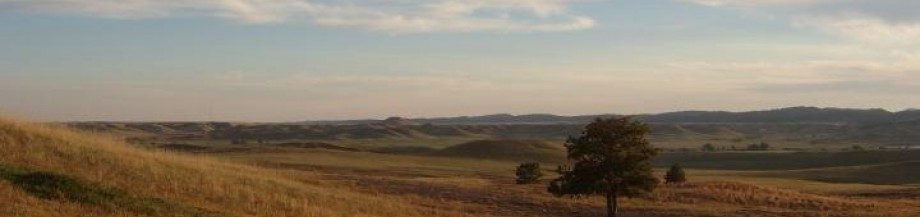
Because of this poignant wondering, for me the trip home was an experience of cherishing and appreciating what was around me. I realized again as I drove just how much I love South Dakota; not the state as a political or geographic entity necessarily, but the land itself. It was late afternoon, so the sun was low and the prairie was at its most beautiful even in late October. The long shadows molded the rolling hills into serene sculptures that extended on either side of the highway for as far as I could see. And I could see for miles.

One of the things I love most about this land is its size. Western South Dakota is sometimes described as bleak and empty. We joke that if it weren’t for the billboards there would be no scenery at all. But we know—those of us who live here because we love it—that this isn’t true. This land is one of the most beautiful places on earth.

The prairie isn’t a glorious spectacle on the scale of the Grand Canyon or the Rocky Mountains or even the canyons of our own Black Hills. Like many of its inhabitants, it doesn’t call attention to itself but waits politely to be noticed. It has a subtle beauty—muted variegations where fall-tinted patches of grass and brush shade into one another; rolling hills with inclines so gradual you hardly notice them until early morning or evening shadows throw them into vivid relief. Even in late fall, when the sparse grass is brown and dry, or in winter when the landscape is white except for the hills swept bare by the ceaseless wind, the placid shadings give beauty and dimension to the prairie.

I drove into the sunset on this day, the sun so far to the south that there was no glare in my eyes as I rolled steadily west on the interstate. This particular sunset wasn’t a dazzling one of bursting oranges and pinks. We have those often, but not on this day. Instead, the sun slowly disappeared behind a bank of deep blue clouds that flanked the Badlands almost as solidly as the ridges of rock themselves. The sky gradually turned pink and purple, the colors spreading across the southwestern horizon with a rich and serene splendor that filled up half the immense sky.

I had started out on this journey the day before, full of agitation. I was harried and hurried and stressed, rushing to meet a deadline in my work, worried that I wasn’t doing enough for a political cause in the last weeks before the election, grieving for my Aunt Marie even as I made this hasty visit to see her for what would probably be the last time.

But by the time I finished my drive across the state and back, most of my tension had dropped away. I was restored and refreshed, reminded both of my attachment to this  land and, paradoxically, of its reassuring indifference to me and to the rest of us who conduct our busy lives on its surface.

This land, like the people who live here, has its weaknesses as well as its strengths, its harshness as well as its beauty. It demands strength and toughness from those who presume to try to make a living on its broad back. One of the qualities it gives in return is the awareness of its endurance. This land has survived, adapting to or outlasting ancient oceans and ice ages, cycles of lush wetness and searing drought, and the ebb and flow of lives extinct and existing. It will continue to abide, long past the spans of human life that come and go like the never-ending wind that sweeps across the plains.

Categories: Living Consciously, Loss and Healing | Leave a comment

Blog at WordPress.com.