Author Archives: Kathleen Fox

The Coin-Operated Time Machine

I went time-traveling yesterday—visiting both the past and the future. I had a fellow traveler, my daughter, and our time machine was the Dew Drop Laundromat.

No, I didn’t climb into a dryer and go spinning off into the past or the future. My body stayed right there in the plastic chair between the first and second rows of coin-operated washing machines.
It was my mind that went traveling.

Just being in the laundromat took me back to those years, well before my daughter was born, when doing the laundry meant stuffing everything into a couple of big baskets and loading it into the car, trying to remember every time to bring along the detergent and the dryer sheets. The memories came back vividly: The sense of impatience, feeling as if I were wasting time as I waited around for the machines to finish. The steamy air, scented with soap and fabric softener. The difficulty of concentrating on a book amid the noise of the machines and the distraction of the inevitable shriek of little kids running back and forth and climbing on the tables. The tinge of discomfort over folding my underwear in public. The secret antagonism toward the other customers, competitors who might get to the empty machines first. The relief of getting home with everything clean, dry, and folded, knowing I wouldn’t have to do it all again until next week.

That was my trip back into the past. It was a brief ramble, completely untouched by nostalgia, that sent me home with a strong urge to dash downstairs and hug the washer and dryer.

My trip into the future was even shorter, but it was far more unsettling.
This visit to the laundromat was my daughter’s chore, not mine, a chance for us to spend some time together while she got her laundry done. She was the one who knew how many quarters the machines took and how long their cycles lasted. She knew where to get change, where the bathroom was, and that the tentatively friendly resident Chihuahua’s name was Amber. I was merely the helper. I was the one sent to the counter to turn a ten-dollar bill into a roll of quarters, the one asking, “Which load do you want this shirt in?”

Being the subordinate in this way, watching my capable and confident daughter who has recently become so grown-up, I got a glimpse of what our relationship may be like in another 25 or 30 years. For just a moment, it felt as if our parent/child roles were reversed.

I didn’t entirely like it. My daughter tells me that when I get old she wants me to come and live with her so she can take care of me. That loving concern pleases me greatly. That doesn’t mean I’m in any hurry to take advantage of it.

Right now I’m in a wonderful position with my young-adult kids. I still have plenty of “mom” status when it comes to giving them support, encouragement, and (solicited—usually!) advice. At the same time, I don’t have to cook for them, bug them to clean their rooms, wait up at night for them, or pay their dental bills. I like that position. I’m free of the responsibilities of day-to-day parenting, yet I’m still respected as “Mom who can help take care of this.”
I don’t look forward at all to giving that up in favor of being “Mom who needs to be taken care of.”

Maybe the wiser course is not to look forward to it. Maybe I should limit my time traveling and focus on enjoying the relationship I have with my kids in the here and now. Maybe it’s a good idea to remember that sometimes the laundry is just the laundry.

Categories: Living Consciously | Leave a comment

The Wisest Words

Communication is the art of using the right words in the right way. Or not. Sometimes good communication means knowing when not to say anything at all.

One day a few years ago I answered the phone to hear a hesitant little voice. “Mom? Um, well, um, I accidentally threw away my retainer.” My daughter, calling home at lunchtime on the second day of fourth grade. “I forgot and put it in the garbage with my lunch sack, and they already took out the trash from the lunchroom. Will you come help me look for it?”

My first reaction was to launch into the standard lecture. You know the one. It starts with, “How could you be so careless?” and ends with, “Do you know how much we paid the orthodontist for that thing?”

Amazingly, on this occasion I managed not to say all those things. I did sigh—just once. (An experienced mother can get an amazing amount of guilt and exasperation into one sigh.) Then I said, “I’ll be there in a few minutes.”

When I got to the school, Ray, the custodian, said cheerfully, “Don’t worry, this happens all the time. We’ve never lost one yet.” He put on disposable plastic gloves, handed us each a pair, and we started digging through the garbage. The retainer was in the second bag, covered with chocolate milk and a bit sticky, but good as new after a thorough washing. With great relief on both sides, I went home and my daughter went back to class.

You might think I was able to stop myself from scolding my daughter because I’m naturally a patient person—or because I’m so wise that I usually think before I speak. I’d love to have you think that. It would be wonderful. Unfortunately, it wouldn’t exactly be the truth.

The real reason I was able to keep my mouth shut was because of something that had happened to me a few weeks earlier.

I had an appointment at my doctor’s office. When I got to the clinic, I parked in a space in the middle of the parking lot. There was no curb there, just one of those concrete dividers about four inches high and four feet long. When I came out after my appointment, I got into the car to leave—and started to drive forward instead of backing up. I got one front wheel over the concrete block that I had forgotten was there. There I was, with one wheel jammed against the far side of the divider and the other jammed against the near side. I was stuck. Thoroughly stuck. Humiliatingly stuck.

There are words that are just right for such an occasion. I said a couple of them, with feeling and emphasis. Then I took a deep breath, dug out my cell phone, and called my husband. “Um, I did something really dumb and got my car stuck. Will you come help me get out?”

He showed up about fifteen minutes later. He didn’t say, “How on earth did you manage to do something so stupid?” He didn’t laugh at me. He didn’t even sigh or roll his eyes. He just jacked up the car, backed it off the barrier, made sure it wasn’t damaged, and sent me on my way.

I was very grateful for what he did to free my car. I was even more grateful for all the things he didn’t say.

Much of the time, the trouble we get into is at least partly our own fault. We forget something, we get careless, or we make a mistake. Quite often, we need a little help to get out of whatever fine mess we’ve gotten ourselves into. What I’ve learned over the years is that sometimes it’s my turn to come to the rescue, and sometimes it’s my turn to be the one who messes up. In the long run, it probably comes out more or less even.

If I can remember that, it’s easier not to say all those scathing words that come so easily to mind when it’s someone else’s turn to be careless. Yes, we all need to be responsible for our actions. Yes, we need to fix our mistakes. Yes, we need to learn not to make the same ones again. And it doesn’t help us a bit to have somebody else point out what an idiot we’ve been. We already know that. A chewing-out that makes us feel dumber than we do already is neither kind nor useful.

When it’s your turn to be the rescuer, try to remember all the times you’ve been on the other end of the predicament. Take a deep breath. Count to ten. Go hide somewhere and rant or laugh if you need to. Then show up and shut up. Whether the person who messed up is your kid, your employee, or your spouse, give them the help they need, but skip the scolding. They’ll learn the lesson perfectly well without your rubbing it in, and both of you will be happier.

Sometimes the wisest words are the ones we never say.

Categories: Living Consciously | Leave a comment

Tomato Anticipation

Gardening, like second marriages, is often a triumph of hope over experience. It certainly is that for me, every spring. Witness the fact that it is now mid-March in South Dakota, and I have just planted tomatoes. In peat pots on the kitchen table, of course—I may be a cockeyed optimist, but that doesn’t mean I’m dumb.

As a gardener, I have become a specialist. Oh, I tried diversification for a couple of years. I spaded, mulched, watered, fertilized, and weeded with energy and concentration. My harvest was a couple dozen stunted ears of sweet corn, a few heads of bitter broccoli with a high protein content (think cabbage worms), a few cantaloupe killed prematurely by vine-munching grasshoppers, and a handful of mediocre cucumbers. But I did succeed in growing tomatoes—with that rich, red-ripe flavor that makes their supermarket counterparts taste like inadequately-ripened styrofoam.

By now, tomatoes are the only thing I plant. I always start them early from seeds instead of waiting to buy bedding plants, because every year I indulge in the fantasy of eating fresh tomatoes by the end of June. One year, indeed, we might have done exactly that if it hadn’t been for that early summer hailstorm. So the possibility remains, strong enough to persuade me into buying fresh potting soil, peat pots, and seeds every March.

I carefully fill each pot, then tuck three tiny, dry tomato seeds into each one. It is incredible to me that each one holds inside its desiccated self the potential of a sturdy plant, several feet high, bearing an abundance of fruit. Later, assuming they all sprout, I will have to choose the strongest-looking plant in each pot and ruthlessly pull the other two, a procedure that always gives me a pang.

Remember in kindergarten or first grade when you got to plant a couple of seeds in a paper cup or a small glass jar? Remember the sense of anticipation as you watered the bare dirt and checked each day to see if anything was coming up yet? And then all at once, like magic, there it was—a tiny green shoot. Then with amazing speed, maybe even by the next day, tiny leaves had unfolded. Then more leaves appeared, and the bean or marigold or whatever it was grew and thrived—at least until you took it home for Mother’s Day and forgot to water it, and it drooped over the side of the cup and died.

Every year, as I carefully plant my tomatoes and gently water them and set them in a sunny window, I feel the same sense of awe and anticipation that I remember from first grade. That is why I have become a gardener—albeit a fumbling and often unsuccessful one. Because, much as I love the taste of fresh tomatoes, gardening for me is less about harvesting than about planting.

It would be different, of course, if we depended on my garden for significant portions of the winter’s food supply. Because we don’t, I have no need to plant seriously and practically. My garden is a small indulgence in one corner of our generous yard. It’s a place I can reacquaint myself with earthworms and dirt under my fingernails, a place to savor the smell of fresh warm dirt and the feel of the spring sun on my back and the satisfying labor of digging. Each year it is a tangible expression of hope and anticipation.  Each spring it is a chance to start over.

And, who knows, this just might be the year that I celebrate my June birthday with a fresh, ripe tomato from my garden.

Categories: Living Consciously | Leave a comment

Civility and Seven-Bean Soup

“Mind your manners. Being polite never hurt anybody.”

Oh, yeah? I beg to differ.

Some years ago, as a divorced mother of two kids, I began dating a man who was also divorced. Early on, when we were both still trying to impress each other, he invited my kids and me over for dinner at his house. He served us seven-bean soup.
There’s nothing complicated about this stuff. It comes prepackaged with seven kinds of dried beans, including ordinary white beans, a couple of odd-looking varieties with spots, and of course the infamous limas. It has spices and seasonings all tucked up in their own little packet, so all you have to do is dump everything into a pot, add plenty of water, and cook it. It’s an easy meal for a busy single parent.

Mike served up the soup with a flourish, and after the first couple of bites he asked me what I thought.

First of all, I don’t like beans. I eat them on occasion, but even though I know they’re good for me I simply cannot bring myself to appreciate them. The taste is okay; it’s the texture I have trouble with—that mixture of graininess and mush that sort of grows in your mouth until you swallow it. To make matters worse, Mike’s seven-bean soup hadn’t been cooked nearly long enough. Some of the beans were still crunchy, and some of them squeaked horribly between my teeth when I bit into them, and the whole mess hadn’t had a chance to simmer until the flavors blended, which is one of the secrets of good soup, bean or otherwise.

But Mike was looking at me expectantly from the opposite end of the table. He had already made it clear that, as a single dad, he was proud of his cooking ability. I didn’t want to hurt his feelings. I didn’t want him to be mad at me. I wanted to be polite.
So I gulped down my mouthful of crunchy bean soup and lied through my teeth. “Oh, yes, I like it. It’s really good.”

Meanwhile, my kids were poking their spoons around in their soup and eating crackers. Mike’s son, who must have been used to the stuff, was eating doggedly. And Mike was beaming. His seven-bean soup was a success.

Now all of this might not have mattered a great deal—one bad meal, one polite lie, one batch of peanut butter sandwiches for the kids when we got home. But Mike and I kept dating for a while. Every now and then the kids and I ate dinner at his house. And almost every time he served us seven-bean soup.

Trapped by my own misplaced manners, I had to eat the stuff and pretend I liked it. My kids, more honest than diplomatic, never managed to choke down more than a few bites and gained undeserved reputations as picky eaters.

All I was trying to do with my seven-bean lie, I thought, was be polite. I just wanted to be nice. I thought I was being courteous. Actually, I was just being cowardly. The lie was simply a knee-jerk response to an awkward situation, my way of avoiding any conflict.

Telling the truth wouldn’t have necessarily meant saying, “Yuck!  I wouldn’t feed this swill to a starving stray dog!”  There were several ways I could have been polite and still made my opinion clear. I could have said something like, “Well, I don’t care much for beans, so I’m not much of a judge of bean soup.”  Or maybe, “I really don’t like beans, but for people who do, I’m sure this is really good.”

Instead, I took the coward’s way out—with unpleasant gastronomic consequences. I put my kids as well as myself in the position of repeatedly having to eat something we all hated. I failed to give Mike some information about myself that would have helped us get to know each other better. I even passed up what might have been an opportunity to tell him gently that beans are better when thoroughly cooked. My polite lie, instead of building a bridge between us, put up a barrier.

Because of that barrier, and many others like it, my relationship with Mike didn’t last very long. I missed him a little at first. There were compensations, though. When he disappeared from my life, so did his seven-bean soup.

Categories: Living Consciously | Leave a comment

Off-Color

My daughter recently got married. As significant family events tend to do, this one highlighted some of the little quirks and dysfunctions that affect our closest relationships. As she and I were busy planning the wedding, I was forced to face a difficult truth about myself.

I know that the first step to recovery is to admit there is a problem. It’s hard to even admit such a failing to myself, much less write it down in black and white. Still, I know that being honest about this dysfunction is essential. Therefore, I am making this public confession. I am seriously decorating-impaired.

I discovered that planning a wedding means making decisions about Important and Significant Issues. Things like centerpieces. Bridal magazines devote entire articles to centerpieces.

Frankly, I don’t understand what all the fuss is about. I have centerpieces at home. The dining room table almost always has something or other in the center of it. Junk mail, usually. Or a half-finished crossword puzzle. Or, since I live with a geologist, a random assortment of interesting (to a geologist) rocks.

Okay, so centerpieces I can handle. I’m still at a loss, though, when it comes to knickknacks. Some people have all sorts of attractive objects strewn about their houses. They drape scarves here and set candles there, and are thrilled when they find some interesting piece of crystal or a pretty bowl at an antique store. I just don’t seem to have the knack for that sort of thing.

It’s a little-known fact, by the way, that “knickknack” is an old word from Sanskrit. Its literal translation is “stuff you have to dust.”

Of course, I do have things strewn about my house. There are the stacks of papers to be filed, the piles of magazines, my four pairs of reading glasses, and the occasional random hiking boot or teacup—not to mention all those assorted rocks.

Despite my disability, I do decorate my surroundings. I even own three paint rollers, four paint brushes, and a stud finder. I’ve painted complete interior walls of entire houses. One of my favorite things about painting is browsing through the color chips—not to look at the colors, but to read the names someone comes up with. Some of the actual colors I’ve used are Seashell, Snow Ballet, Early American Champagne, and my all-time favorite that I bought just because of its name—Pudding.

No matter how colorful their names might be, though, all those paint colors have one thing in common. Every one of them is off-white. Snow Ballet or Early American Champagne just sound so much more appealing than “beige.”

It isn’t that I don’t like color. I love color. I especially like the way it shows up against all those off-white walls.
In my office hangs a brightly-colored quilted pinwheel that my mother made for me. I picked out the fabric myself—four different shades each of four different colors. That’s sixteen separate and distinct pieces of fabric. It took me three hours, and by the time I got out of the fabric store my decorating disability had kicked in so badly that I had to go home and take a nap.

I know there is help out there for this failing of mine. There are entire magazines dedicated to the art and science of decorating one’s home. They have names like House Beautiful or Better Homes and Gardens. I’ve even seen one—this is a bit scary—called Bathroom Yearbook. I just can’t force myself to use these recovery materials. The only time I look at one is at the doctor’s office when the only other choice is a medical magazine with a name like Kidney Dysfunction Journal.

Because of my reluctance to change, I have decided my best choice is to learn to live with my decorating disability. It really doesn’t  impair my ability to lead a normal life. It isn’t causing difficulty in my significant relationships. I honestly believe I can manage my affliction.

One thing I need to do is learn not to blame myself. This doesn’t mean I’m a bad person or that there is something wrong with me. And after all, it really isn’t my fault. I can’t help it. I simply was born without any designer genes.

Categories: Just For Fun | Leave a comment

Paper Lions

Reading the newspaper with breakfast and a cup (or two or three) of tea is an important part of my morning. My day doesn’t quite start properly without it.

The good news is that our newspaper is delivered reliably. It’s there in its little white plastic box every morning by 5:30 or 5:45. The bad news is that the newspaper box is out at the street, at the end of our sloping gravel driveway, about 100 feet from the front door.

During the summer, this isn’t a problem. The trek after the paper is a pleasant little jaunt in the early morning, a chance to take a few deep breaths of cool morning air and get a first taste of what the day will be like.

During the winter, it’s different. For one thing, going after the paper becomes a project, involving putting on a coat and trading my cozy knit slippers for a pair of snow boots. That isn’t the real problem, though. Even when it’s cold or there’s snow on the ground, it’s still pleasant to get outside in the freshness of early morning.

The real problem is the mountain lions.

We certainly do have mountain lions here in the Black Hills. The population is increasing, and every now and then one is seen in town. A while ago, one even grabbed a small dog as a snack while the dog’s owner was out in the yard only a few feet away.

Still, I’ve never actually seen a mountain lion. In truth, I’ve never actually seen a mountain lion track. The risk of encountering a mountain lion in my own front yard is miniscule. I’m far more likely to be injured by slipping on a patch of ice or stumbling on the gravel. The trouble is, though, that at 6:00 or 6:30 in the morning in the winter time, it’s still dark. And when I start up the driveway, I can’t help thinking about mountain lions.

Once I start thinking about lions, it’s only one short imaginary step to seeing them behind every rock and pine tree. I stay exactly in the middle of the driveway—that means I might be two pounces away from the nearest hiding place instead of just one. I walk as fast as I can, but I never run. I might slip on the gravel, and besides, they know you’re afraid if you run.

I speed-walk up the driveway, grab the paper out of the box, and start back toward the house. The trip back is worse than the trip up, because all the critters my mind has conjured up are behind me. So I scoot down the driveway—is that heavy cat-breathing I hear in the shadows behind me? I trot across the grass—I’m almost there; maybe it won’t get me this time. I scurry up the steps onto the porch—thank goodness, I made it again!

By the time I’ve started my morning with this self-inflicted dose of adrenaline, I hardly need a cup of tea.

My partner expresses his sympathy and understanding by saying, “If you do get attacked, could you please just toss the paper toward the house? That way it won’t get shredded by the lion’s claws, and I’ll still be able to read it.”

Most winter mornings, I just let him go up and get the paper.

Categories: Just For Fun | Leave a comment

Please, Go Ahead and Spend It

When my Uncle Ernie, a life-long bachelor, was in his 80’s and in declining health, he moved into an assisted living facility. He complained to my mother that living there was going to use up all his savings. Her answer was, “What do you think that money is for?”

A close friend’s elderly mother is currently in a similar situation. Nearing 90, she has enough money to provide comfortably for her needs—including assisted living or nursing home care, if necessary—for the rest of her life. Yet she frets about spending it. She tells her two sons, “That money is supposed to be for you.”

No, it isn’t. That money is supposed to be for her.

All sorts of investment options, from IRAs to 401(k) plans, are described as “retirement funds.” We talk routinely about “saving for retirement.” Providing for our needs in old age is one of the most important reasons for saving in the first place.

Yet, when retirement comes, it’s not easy to start spending that money. Such reluctance is understandable. When you’ve been in the habit all your life of saving and putting money away, it’s hard to make a 180-degree turn and start spending it instead. It may feel like jeopardizing the security you have from knowing that money is there. In addition, many people want to leave a legacy to their children or to charity.

There’s nothing wrong with wanting to leave money to your children. But the money you’ve saved for your retirement is yours. It’s there to provide for you. Your children aren’t automatically entitled to it, and you don’t owe it to anyone.

Speaking as a middle-aged daughter of elderly parents, what sort of legacy do I want from them? When it comes to material things, all I really care about are the family keepsakes which are valued for what they mean rather than what they are—such things as my mother’s handmade quilts and my father’s books. What I want most, though, is to have my parents in my life for as long as possible. I want them to be comfortable, able to have more than they need and to do things they enjoy. I want them to use their resources for themselves so they can be an active presence in my life and the lives of my children.

If it’s hard for you to think about spending your life savings on yourself, you might consider this: Taking care of yourself is not taking anything away from your children. Instead, it’s a way of giving to them. When you have—and use—the resources to provide for your own needs, your children don’t have to take care of you. That leaves them free to build their own savings.

So please, when you get to a point where it’s time to start using what you’ve saved, go ahead and use it. After all, as my mother would remind you, what else is it for?

Categories: Money Matters | Leave a comment

The Prairie

On a late afternoon in October, I drove across western South Dakota. I was on my way home from visiting my Aunt Marie, who was dying of cancer. I had wondered as I left the hospital what it would be like to lie in bed, able to see only the small, impersonal room with a little glimpse of grass and a spindly elm tree outside, knowing these would probably be the last things in this world one would see. I wondered if she missed the familiar surroundings of home.

Marie had lived in her house for over 25 years. Did she wish she had looked at it more carefully before she left for the last time? Did she think then that it would be the last time? Did she wish she could die in her own bed, in her own home? Would she like to look out her front door one last time and say goodbye to the neighborhood? Would she want to see all her things or go through a box of treasures one final time, or even look at the night sky or watch a flock of geese heading south? How important would all these things be? Would there be a sense of sadness, an awareness of how precious these things have been? Not the things themselves, but the life they represent or the beauty and wonder of them. Or would none of it matter? Maybe by now she was tired enough and in enough pain so she was ready to move on. Maybe the trappings of this life had ceased to have any significance. In a way I hoped so. I didn’t know, and there was no way to ask.

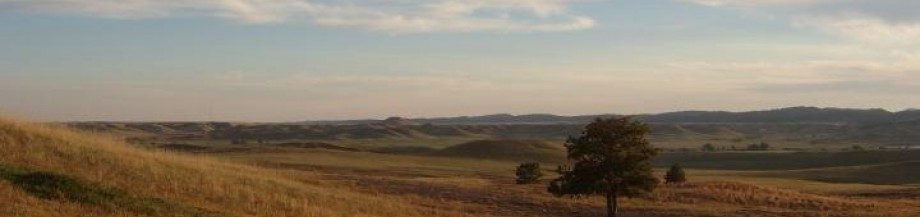
Because of this poignant wondering, for me the trip home was an experience of cherishing and appreciating what was around me. I realized again as I drove just how much I love South Dakota; not the state as a political or geographic entity necessarily, but the land itself. It was late afternoon, so the sun was low and the prairie was at its most beautiful even in late October. The long shadows molded the rolling hills into serene sculptures that extended on either side of the highway for as far as I could see. And I could see for miles.

One of the things I love most about this land is its size. Western South Dakota is sometimes described as bleak and empty. We joke that if it weren’t for the billboards there would be no scenery at all. But we know—those of us who live here because we love it—that this isn’t true. This land is one of the most beautiful places on earth.

The prairie isn’t a glorious spectacle on the scale of the Grand Canyon or the Rocky Mountains or even the canyons of our own Black Hills. Like many of its inhabitants, it doesn’t call attention to itself but waits politely to be noticed. It has a subtle beauty—muted variegations where fall-tinted patches of grass and brush shade into one another; rolling hills with inclines so gradual you hardly notice them until early morning or evening shadows throw them into vivid relief. Even in late fall, when the sparse grass is brown and dry, or in winter when the landscape is white except for the hills swept bare by the ceaseless wind, the placid shadings give beauty and dimension to the prairie.

I drove into the sunset on this day, the sun so far to the south that there was no glare in my eyes as I rolled steadily west on the interstate. This particular sunset wasn’t a dazzling one of bursting oranges and pinks. We have those often, but not on this day. Instead, the sun slowly disappeared behind a bank of deep blue clouds that flanked the Badlands almost as solidly as the ridges of rock themselves. The sky gradually turned pink and purple, the colors spreading across the southwestern horizon with a rich and serene splendor that filled up half the immense sky.

I had started out on this journey the day before, full of agitation. I was harried and hurried and stressed, rushing to meet a deadline in my work, worried that I wasn’t doing enough for a political cause in the last weeks before the election, grieving for my Aunt Marie even as I made this hasty visit to see her for what would probably be the last time.

But by the time I finished my drive across the state and back, most of my tension had dropped away. I was restored and refreshed, reminded both of my attachment to this  land and, paradoxically, of its reassuring indifference to me and to the rest of us who conduct our busy lives on its surface.

This land, like the people who live here, has its weaknesses as well as its strengths, its harshness as well as its beauty. It demands strength and toughness from those who presume to try to make a living on its broad back. One of the qualities it gives in return is the awareness of its endurance. This land has survived, adapting to or outlasting ancient oceans and ice ages, cycles of lush wetness and searing drought, and the ebb and flow of lives extinct and existing. It will continue to abide, long past the spans of human life that come and go like the never-ending wind that sweeps across the plains.

Categories: Living Consciously, Loss and Healing | Leave a comment

The Cut (Fiction)

Today is the 39th day, and I am cutting my hair.

The girl at the salon—her own hair a gelled tousle of improbably maroon curls—exclaims over the length and asks me how long I’ve been letting it grow.

“Twenty-seven years,” I say, and she lets out a sound halfway between a shriek and a gasp.
“My God!  That’s, like, six years longer than I’ve even been alive!”

Then, perhaps realizing that the exclamation has been something less than tactful, she draws herself together and becomes briskly professional. Am I sure I really want to do this? Yes, I am. I don’t want to take off maybe just half of it and see how that feels? No, I don’t. Shoulder length, for sure? Yes, I’m sure.

So she unclips the barrette at the back of my neck, loosening my hair so she can comb through the shining brown length with its threads of gray. Her neighbors from the adjoining chairs, clients and stylists alike, neglect their own hair in order to watch as she lets it flow across her outreached arm so she can reach the ends with her comb. Then she begins to braid it. I watch in the mirror as her slender fingers with their green-enameled nails flash deftly through the strands. Her young face, bent to her task, holds the solemnity of a novice priestess or a small child intent on a puzzle.

She finishes the braid, fastens the end with an elastic band, and snaps a second one around it near the top. Then she pulls the plait out sideways to its full length, nearly three feet, so I can see it in the mirror.
“Last chance,” she says, and her reflected image smiles at my reflected image, inviting me to change my mind.

I don’t smile back.
“Go ahead,” I tell her.

She takes a deep breath and reaches past my shoulder to pick up her scissors.  Gripping the braid in her small fist, she pulls it out away from my neck until my head rocks backward, then begins to chew at it with her scissors. I feel rather than hear the blades gnawing their way through the thickness of the braid, severing a bit at a time. The cropped strands fall forward one after another, curving past my ears until the ends tickle my jaw. In the mirror the girl’s mouth is twisted with concentration.

Suddenly my head snaps forward as the final tresses separate. The breath I had not known I was holding comes out in a deep sigh at the same time she says, “There!” in triumph and relief. She holds the braid—her victor’s trophy—high for a moment, then drapes it across my lap. I work one hand out from under the smock so I can hold it.

I stroke the glossy strands with my thumb while she finishes her work. Relief loosens her tongue as she trims and evens the ends, parts my hair on one side, shapes and combs it into a sophisticated bob that barely brushes my shoulders. She asks about my job, my children. I answer briefly but with courtesy. She is trying to put both of us at ease after the rite we have shared; the least I can do is respond to her efforts.

“How’s that?” she asks at last, her young eyes meeting mine in the mirror, wanting my appreciation. “It’s going to feel funny for a while.”

I shake my head experimentally, feeling the hair swing across the back of my neck and brush softly past my cheek, hearing the whisper as it sweeps across the nylon smock covering my shoulders. “Yes,” I tell her. “I like it. You did a good job.”

She brushes the hair off my neck and frees me from the smock, and I follow her to the cash register, clutching the braid that she obviously expects me to keep. What am I to do with it? Drape it across my bedroom mirror? Tuck it away in my underwear drawer? I imagine my fingers brushing against it as I reach into the drawer; it would be like finding an escaped ferret among my bras and panties.

I clutch at a dimly-remembered alternative. “Isn’t there an organization that collects hair to make wigs? For cancer patients or something?”

“Oh, sure. We have a cut-a-thon for them once a year. You want to donate it? We can send it in for you.”

By all means. I hand over the snake of hair, and she slings it over her shoulder.
Then it comes, with a bright smile as she counts out my change. “I bet your husband will be surprised. Think he’ll like it?”

My fingers tighten on the handful of bills and coins. “No, he won’t be surprised.”

I fumble for the door handle and go out blinking into the brightness of the day.

My friends will probably think I cut my hair now because Alan had wanted me to keep it long. That I am free now to do whatever I want with it.
If they believe so, they are mistaken. Yes, Alan had liked my long hair, had let its softness flow through his fingers, had tugged gently on the braid I often wore as a shorthand for, “Hey, kiddo, I love you.” But several months ago, when I had brought up the idea of cutting it, he had shrugged. “If you don’t like it short, you can always let it grow back. It’s your hair. Do whatever you want.”

That was the trouble. I didn’t know what I wanted. My long hair had been part of me since high school. It was unique. It was part of my signature. Yet I was tired of the weight of it, the sameness. I thought sometimes it labeled me as the leftover hippie I had never been. So I decided to cut it, changed my mind, waffled, fretted.

Then came the late-night knock and the patrolman at my door with his professionally gentle words. “I’m so sorry, ma’am; there’s been an accident. Your husband’s car . . .” My world shattered around me as I stood there in the robe Alan had given me for Christmas, my hair in its nighttime braid down my back.

Now, 39 days later, that long hair is gone. My friend Sarah always says, “A woman who cuts her hair is a woman in transition.”

Well, Sarah, I tell her in my mind, in transition I certainly am. But after all the indecision and fretting, I know now what cutting my hair really means. You know what, Sarah? It doesn’t mean shit. That’s why I did it now. Because I finally figured out that it just plain doesn’t matter.

I get into my car, stab my key into the ignition, start the engine, pull out of the parking lot toward my empty house. It’s just hair. It can come back.

Categories: Loss and Healing | Leave a comment

A Rose Is a Rose Is a Decorative Horticultural Happening

Is the truth a bit too plain, even a trifle painful? No problem—just call it something else. This is the mantra of creative marketers, selfless souls all, whose purpose seems to be to save us from the harsher realities of life and get us to buy something at the same time.

Real estate agents, of course, have been doing this for years.  Describing a house as having “loads of personality” means “we hope you won’t notice that there’s no closet space.”  “Quaint” translates to “plumbing last updated in 1927.”  “A view to die for?”  It overlooks the cemetery.

This kind of creative renaming has expanded far beyond real estate ads. When, for example, did a movie become a “motion picture event?”  Most often it’s a “major motion picture event,” unless it’s based on a literary classic or an incident from history, in which case it’s an “epic motion picture event.”

There’s certainly nothing wrong with calling a movie a motion picture.  I can even live with “major motion picture.”  After all, no one is going to invest the time and money to produce a film and then advertise it as a “minor motion picture.”  But why tack “event” onto the end?

It seems to me that “motion picture event” more appropriately describes something that happens during a movie.  Suppose you are at the theater, and the guy in front of you gets a call on his cell phone.  He keeps yakking and yakking until finally you can’t take it any longer.  You leap over the seats, grab the phone out of his hand, and use it to thump the bejeebers out of him.  Now, that would be a motion picture event.

Since such behavior would probably get you banned from the theater, you’d have to entertain yourself at home.  You might choose to read, perhaps enjoying that descendant of the humble comic book, the “graphic novel.”  Or you might watch TV—where a movie, of course, is a “major television event.”  If you did, you’d never see something as blasé as a mere rerun of an earlier program.  Instead, you might watch that crowning glory of creative euphemism, the “encore presentation.”

If an encore presentation of last year’s reality show doesn’t hold your interest, you might decide to go shopping.  The renaming game is alive and well here, too, especially when it comes to clothing. 
The current trend is to describe clothes by what one is supposed to do in them.  You can buy sleepwear, loungewear, activewear, sportswear, leisurewear, and careerwear.  But what if, in the privacy of your own home, you decide to sleep in your loungewear?  Or lounge in your activewear?  How are they going to know?

Oddly enough, something we don’t buy any more is plain old “underwear.”  Instead, we shop discreetly for “intimate apparel.”  Nor does any woman today have to subject herself to the kind of intimate apparel once known with such uncomfortable directness as a “girdle.” She can now hold herself together much more gently with “shapewear.”

Slacks and blouses have been dumped into the all-purpose categories of “bottoms” and “tops.”  This terminology is not without its risks; a while ago I saw an ad for “plus size women’s bottoms—half off!” Don’t we all wish.

That particular ad, with the incredible breadth of its vision, has inspired me.  Instead of deploring this creative renaming game, I’ve decided to join in it.

For example, last summer my garden was a dismal failure if you considered it a place to produce vegetables.  I renamed it a “grasshopper habitat.”  It was instantly a thriving operation—as well as a perfect complement to the back yard “dandelion refuge.”

Using this same logic, the dining room table becomes a “newspaper and junk mail deposit area.”  My desk, once a surface cluttered with piles of paper, is now a “horizontal holding facility for documents needing attention.”  My untidy daughter used to have a bedroom with clothes all over the floor.  Now she inhabits a spacious “walk-on clothes closet.”  And since that space under the bed is now a “dust bunny sanctuary,” I certainly can’t disturb its ecosystem by vacuuming.
 

This renaming has its place outside the home, too.  When I rear-ended someone a while ago, I wasn’t being careless—I was just practicing “overly-assertive merging.”  Want to escape the stigma of overdrawing your checking account?  No problem—you’ve merely done “anticipatory pre-deposit spending.”  Have to give a speech?  Those butterflies in your midsection aren’t a sign of stage fright.  You merely have “oration-induced intestinal activity.”  I used to be a procrastinator—no longer. Now I can proudly say I have a “deadline-driven work style.”

This is only the beginning; there are some real possibilities here.  I’ll have to come up with them later, though, because I need to go get dinner started.  I’m sure it’s going to be a satisfying gastronomic event—we’re having an encore presentation of last Tuesday’s meatloaf.

Categories: Just For Fun | Leave a comment

Blog at WordPress.com.